
Tag: MPUserMeeting

  • User innovation takes center stage at 2024 Mass Photometry Summit

    User innovation takes center stage at 2024 Mass Photometry Summit

    The remarkable evolution of mass photometry was celebrated at the annual mass photometry user summit. From prototype to commercially available instrument used in hundreds of laboratories, this innovative technology was on display at the third annual scientific meeting of this event – dedicated to mass photometry users and hosted by Refeyn. The event took place at Wylie Conference Center on May 22 in Beverly, Massachusetts, a coastal suburb of Boston, USA.

    8a9b7f_ca73e53de4ca4e9f8ab43f63da9ff61f~mv2.jpg.webp

    Aerial view of Tupper Manor, the venue for the 2024 Mass Photometry Summit

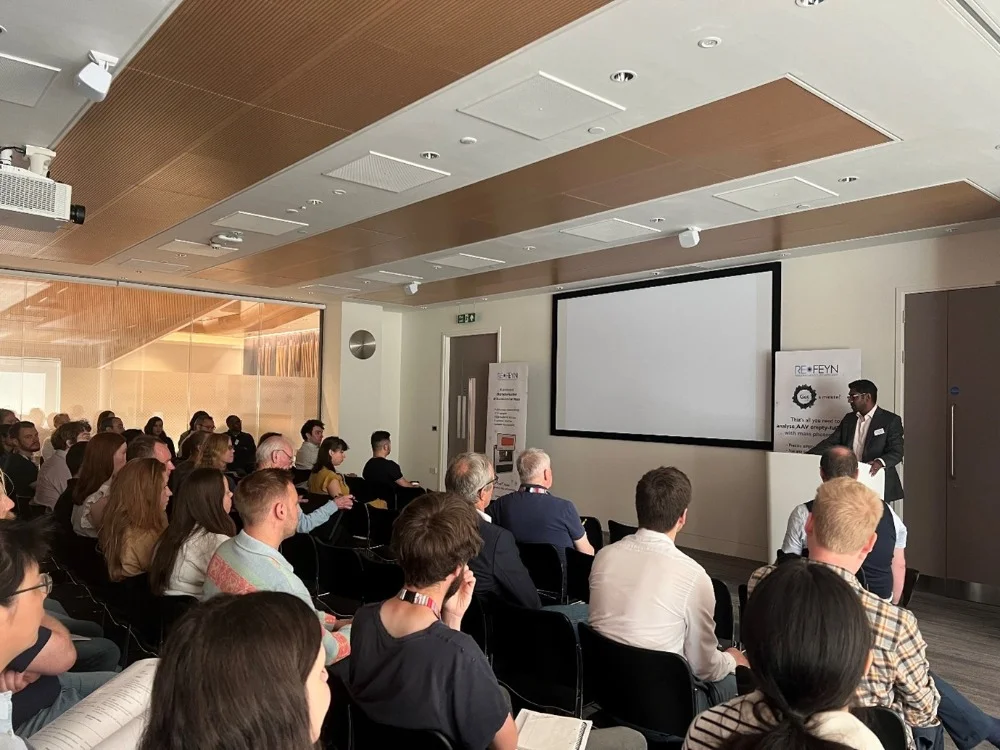
    The meeting brought together mass photometry users, who shared how they use the technology to solve key biomolecule characterization challenges in their own research. Refeyn scientists shared developments in applications and products and gave demonstrations.

    8a9b7f_71440ef4f9ec42a6b04a871347243d5c~mv2.webp

    8a9b7f_d4b2c201fa2348669d420a4d94622992~mv2.webp

    8a9b7f_20220abb502b43a599ade6b142d97625~mv2.webp

    8a9b7f_926076c9e2cc4840adde230a85b40df9~mv2.webp

    Opening the event, Refeyn’s Chief Commercial Officer, Paul Davies, commented on the impressive number of attendees at this year’s event, underpinning the rapid deployment of mass photometry for biophysical characterization of biomolecules.

    Professor Philipp Kukura, one of Refeyn’s founders, told attendees about the technology’s origins, recounting stories of developing and testing instrument prototypes at the University of Oxford, England. He noted that, in those early days, the technology’s potential was obvious, and the key question was not “What can mass photometry do?” but “What can mass photometry not do?”.

    From investigating oligomerization and macromolecular assembly to analyzing adeno-associated viruses (AAVs), users’ presentations and posters showed off much of what mass photometry can do – and how users are pushing it even further.

    8a9b7f_36c6fb144105421f88cb65c026c9d668~mv2.png.webp

    Di Wu of the National Institutes of Health, an early adopter of mass photometry, talked about SEC-MP, a technique he and colleagues published in 2023. It uses a combination of size-based separation, UV detection and mass photometry analysis to determine the titer and empty/full ratio of AAV samples containing aggregates and other impurities.

    Also speaking about AAV analysis was Patrick Lehmann of the University of Pennsylvania, whose comparison of mass photometry vs. analytical ultracentrifugation demonstrated mass photometry’s value as a robust tool for evaluating AAV capsid content. These findings highlight the potential role for mass photometry as a tool in the manufacturing of AAV-based therapeutics. 

    Ross Larue of The Ohio State University described how his wish to “drill holes in his mass photometer” led him to become an early tester of Refeyn’s MassFluidix HC system. Using the system, he said, his group was able to make breakthroughs in understanding viral intasome assembly that would not otherwise have been possible.   

    The day’s keynote speaker was Priyamvada Acharya from Duke University School of Medicine, whose work focuses on the HIV-1 envelope. Her talk was entitled Applications of mass photometry in the study of viral entry machines. 

    Other speakers were Lauren Salay of the University of Washington, who spoke about regulation of the enzyme PFK, Matt Bochman of Indiana University, who presented Dynamic DNA exchange by the telomere binding protein Cdc13.

    The event concluded with an afternoon reception, which included posters as well as instrument demonstrations. Scientific discussion was rich as attendees enjoyed hors d’oeuvres and an open bar.

    Closing remarks were given by Refeyn’s CEO, Gerry Mackay, and Chief Commercial Officer, Paul Davies, who emphasized the importance of this event to help maintain continued collaborations between Refeyn and users of mass photometry to push the boundaries of what this now-established technique is capable of.
  • Mass photometry community comes together in Oxford

    Mass photometry community comes together in Oxford

    Mass photometry has reached a new landmark, as the world’s first mass photometry-themed scientific meeting took place on June 14th at the University of Oxford.

    The first Mass Photometry Symposium and User Meeting, held in June, created an opportunity for researchers with a common interest in mass photometry to come together – even if their fields are otherwise quite different. Around 50 participants representing 18 universities and companies joined Refeyn representatives on the day to talk histograms, calibration, socks with dots, and all other aspects of mass photometry. 

    824bf4_c2fe2d20ae6f4160b265b166f0e67aea~mv2.jpg.webp

    Refeyn CEO Anthony Fernandez welcomed around 50 participants to the first Mass Photometry Symposium and User Meeting. © Işıl Şenol, Kavli Institute for Nanoscience Discovery, University of Oxford.


    Presentations, interactive sessions and informal chat 

    The day began with a welcome from Refeyn CEO Anthony Fernandez. Then, Refeyn co-founder and University of Oxford professor Philipp Kukura recounting the history of mass photometry, including the surprising role that a rickety table played in helping his team discover the robustness of the technology. Participants then presented their mass photometry-related research in talks and posters, with additional presentations from Refeyn. Illustrating the many ways mass photometry can be used, the researchers touched on the studies of macromolecular assemblies, SARS-CoV-2 spike protein-ACE2 receptor interactions, enzyme diffusion, and combining mass photometry with TIRF microscopy, among other things.

    The afternoon was interactive, with time for small-group discussions on mass photometry applications and software, tours of the Kukura lab, and live demonstrations of the TwoMP instrument. Attendees had the chance to ask questions about the technology and discuss it with Refeyn experts and researchers who work on mass photometry in the groups of Professor Kukura and fellow co-founder, Professor Justin Benesch.

    824bf4_76919ed9908c4f8ca9b84cc4039d9ffa~mv2.jpg.webp

    Demonstrations of the TwoMP mass photometer were part of the event. © Işıl Şenol, Kavli Institute for Nanoscience Discovery, University of Oxford. 

    Most importantly, participants had the chance to share ideas and tips with one another. Attendees told us that getting to spend the day with other mass photometry users was one of the best things about the event.

    “It’s very nice to be surrounded by so many people that are using the same technique,… and I’ve had some fantastic ideas about my project come up during some of the chats.”

    Yulia Yancheva, PhD student, University of Groningen


    Recognition for mass photometry researchers 

    Two researchers were recognised for their excellent presentations. Francesca Chandler, a PhD student from the University of Leeds, received a prize for her talk, “First-in-class deubiquitylase inhibitors reveal new enzyme conformations.” She has been using mass photometry to measure the stoichiometry of protein complexes and how they change in the presence of small molecules, and said: 

    “With mass photometry, we’ve been able to do titrations of small molecules to analyze exactly at which concentration we see a change in complex formation.”

    Francesca Chandler, PhD student, University of Leeds

    Chandler has also used mass photometry to assess the purity of samples for cryo-EM, something she previously had done using negative stain EM. “Typically I can check the sample in one minute by mass photometry, whereas my negative stain would have probably taken a couple of hours and then a few more hours to process and analyze the quality of the sample.”

    8a9b7f_f208f57c3a3444b581750f03589070b9~mv2.jpg.webp

    Francesca Chandler, from the University of Leeds, received a prize for her talk, “First-in-class deubiquitylase inhibitors reveal new enzyme conformations.” © Işıl Şenol, Kavli Institute for Nanoscience Discovery, University of Oxford.

    The poster prize went to Josh Bishop, a PhD student from the University of Oxford, for his poster, “Multidimensional Mass Photometry.” Bishop, whose work focuses on extracting information on the organization and charge of proteins using mass photometry, explained what had attracted him to the technique. 

    “One thing that captured me and still captures me about mass photometry is the visual aspect… Straightaway you see what is happening – dynamically, in real time.”

    Josh Bishop, PhD student, University of Oxford

    Building a mass photometry community 

    Professor Benesch closed the meeting, inviting participants to join for an informal social in Oxford before returning home. He emphasized how important the mass photometry user community has been – first in taking a chance on the technology in its early days and now in continuing to find new, innovative ways to use it. He said he hoped this event had helped to further build that community, and that everyone would return next time.  

    The meeting was hosted and co-organized by the University of Oxford’s Kavli Institute for Nanoscience Discovery, where Professors Kukura and Benesch are based, and Refeyn. The meeting and demonstrations were held in the Kavli’s beautiful new Dorothy Crowfoot Hodgkin Building.   

    824bf4_91054e1f9dbb4efbba427b3014aa3f26~mv2.jpg.webp

    Refeyn co-founders Philipp Kukura (left) and Justin Benesch (right) at the Symposium. © Işıl Şenol, Kavli Institute for Nanoscience Discovery, University of Oxford.